
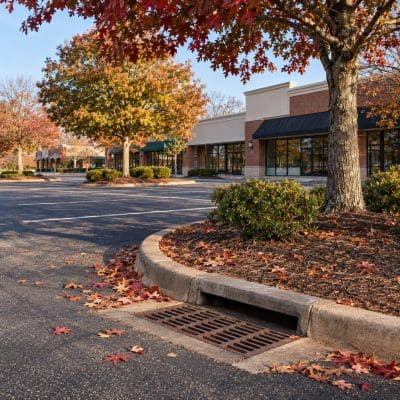
Leaf sweeping at a Salisbury retail property should include the corners customers do not see from the main drive. Landscaped islands, rear service lanes, cart areas, and the spaces beside wheel stops can collect material while the center of the lot still looks clear. A useful request identifies those locations and explains how a provider can reach them.
For a property manager, leaf sweeping is also a coordination task. Landscaping, tenant deliveries, litter checks, and pavement cleaning may happen under different arrangements. The work becomes easier to organize when those responsibilities connect in a written plan instead of being left for crews to sort out on arrival.
Look behind the storefront row
Start with the rear service lane and the corners around loading doors. Check fence lines and the sheltered sides of dumpster enclosures from an appropriate safe position. Note whether the material is ordinary leaf litter or a mixture that includes packaging and larger debris.
Leaf sweeping should name the accessible service areas included in the visit. If tenants control individual enclosures or loading spaces, confirm permission and access. A contractor cannot assume a closed gate or a tenant’s storage area belongs to the general parking-lot scope.
Take photographs of the affected corners and mark them on a simple plan. Include narrow turns, clearance limits, and known surface damage. These details help the provider discuss a suitable route and identify places requiring another collection method.
Connect leaf sweeping with landscaped islands
Islands can interrupt the route through a parking lot and create edges that need special attention. Ask when the landscape crew will handle adjacent leaves and where that material will be placed. The final pavement pass should fit the sequence of work.
Leaf sweeping should collect material for appropriate removal rather than shift it toward a drain. Nearby Charlotte’s yard-debris guidance emphasizes keeping leaves out of streets and storm drains. The general principle is useful for commercial maintenance, while the actual disposal arrangement must suit the property’s jurisdiction and material.
Keep landscape decisions with the appropriate provider. Leaves in an intended planted area are a different issue from leaves covering traveled pavement. The work order should explain the boundary instead of calling for indiscriminate removal from every part of the site.
Identify surface-drain approaches
Locate visible inlets and note the curbs or paved channels leading toward them. Those approaches are useful inspection points because they show where material collects. Include accessible surface cleaning in the request where it is needed.
Leaf sweeping is not an inspection of the underground drainage system. If ponding continues after visible material is removed, report the observation for further assessment. Damaged covers, structural issues, and grading problems require a different response from routine pavement collection.
Do not ask an ordinary cleaning crew to open or enter drainage structures as an assumed part of the visit. Define the surface scope, document what remains, and arrange any additional service with the appropriate provider.
Give tenants a specific parking notice
Vehicles can prevent access to leaf accumulation beside wheel stops and curb returns. Tell tenants which sections need to be empty and when. If the property can offer alternate parking, describe it clearly and preserve the necessary access arrangements.
For leaf sweeping, consider a staged route when the center cannot clear every row at once. Coordinate the work with deliveries, waste collection, and early staff arrivals. Posted opening hours rarely show all the activity that affects a service lane.
Ask how blocked areas will be reported. A section unavailable during the visit should remain visible in the record. Clarify whether a later pass is included or needs separate scheduling so both the manager and tenants understand the arrangement.
Describe bulky or mixed debris before the visit
A few scattered leaves are different from a deep pile containing branches or abandoned items. Send current photos and explain the approximate extent of the accumulation. The provider can then discuss whether additional collection is needed before the sweeping route can be completed.
Leaf sweeping also needs a defined destination for the collected material. A mixed pavement load may contain sediment and litter as well as leaves. Do not assume every yard-waste option will accept it. Confirm loading, transport, disposal, and any separately arranged handoff.
Consider a hypothetical shopping center with mature trees near the side boundary and a busy rear loading lane. Its plan might include separate bulky-item removal, coordinated landscape cleanup, and a final pass through accessible pavement. The sequence is specific enough to review without assuming all retail properties need identical service.
Check the work at repeatable points
After leaf sweeping, inspect the same corners, island edges, and inlet approaches used in the initial walk. Review the contractor’s notes about obstacles and incomplete areas. Keep the original scope available so the result is judged against what was actually requested.
A short checklist can cover:
- Named parking sections and service-lane areas.
- Accessible curb edges and landscaped-island approaches.
- Surface-drain areas included in the scope.
- Vehicles or gates preventing access.
- Remaining material requiring separate work.
Use the next inspection to decide whether the service interval fits the tree cover and property activity. New leaves can arrive after a completed visit. Distinguish that accumulation from a section the crew never had access to, and discuss the next leaf sweeping decision using the record.
Arrange the scope with Paradise Sweeping
Paradise Sweeping provides parking lot sweeping and other pavement services for Salisbury and its North Carolina service area. Share the landscape schedule, tenant access restrictions, and priority corners when requesting a proposal.
To plan leaf sweeping for your retail property, contact Paradise Sweeping. A marked site plan and current photographs give the team a practical starting point for discussing the route, service window, and collection responsibilities.